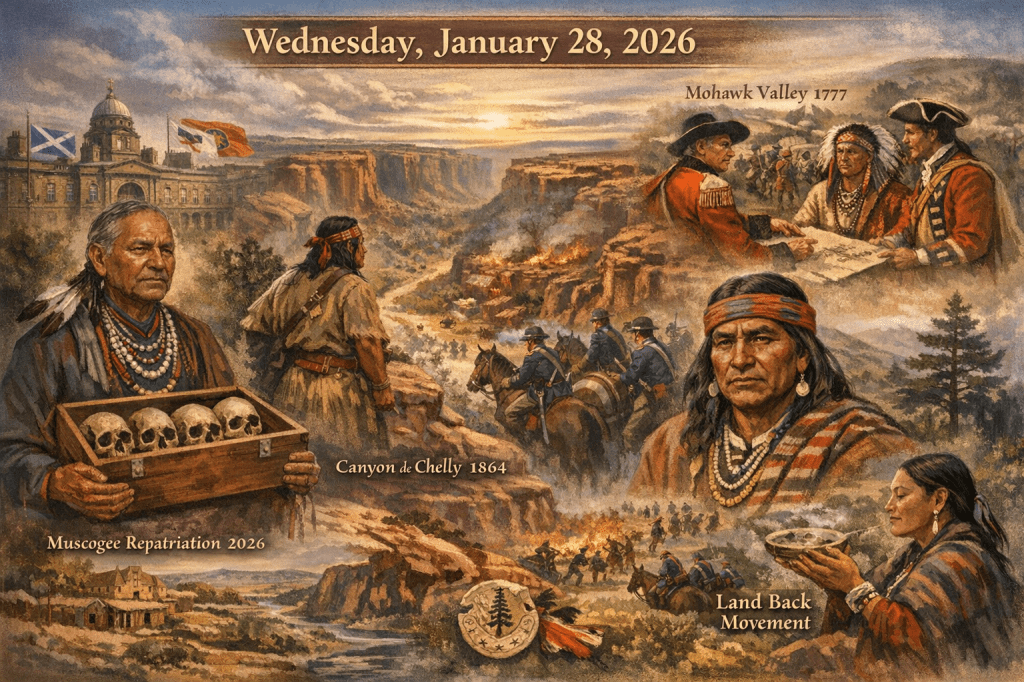
Wednesday, January 28, 2026
January 28 serves as a profound date in Indigenous history, marking both the tragic military campaigns of the 19th century and groundbreaking modern milestones in sovereignty, international repatriation, and the reclamation of ancestral lands.
Key Historical Events (January 28)
- Muscogee Nation’s International Repatriation (2026): In a historic first, ancestral remains were returned to the Muscogee (Creek) Nation from the University of Edinburgh in Scotland. This event marks the first-ever international repatriation of Indigenous remains to the U.S. mainland. The six skulls were taken in the mid-1800s for a Phrenological Society collection used to promote racist pseudo-science. These ancestors were originally removed from burial sites across the Southeastern United States.
- Siege of Canyon de Chelly (1864): During the Long Walk of the Navajo, U.S. military forces under Colonel Kit Carson sought to break the resistance of the Diné. On January 28, 1864, Carson’s troops entered the west end of the canyon and encountered a band of Navajo, killing 11 people. Carson continued a “scorched earth” campaign, ordering the destruction of food stores and thousands of cherished peach trees. This devastation forced thousands to surrender and begin a 300-mile forced march to the Bosque Redondo internment camp.
- British Strategy in the Mohawk Valley (1777): General John Burgoyne submitted a plan to the British government to isolate New England by invading through the Mohawk River valley, the heart of the Haudenosaunee (Iroquois) Confederacy. This maneuver forced Indigenous nations into complex war alliances that permanently altered their sovereign territories.
- Siege of Moho Pueblo (1541): On this day, Spanish forces under Francisco Vasquez de Coronado began a siege of the Moho pueblo, a center of resistance against Spanish incursions. The siege ended with a massacre of over 200 people.
The Navajo Treaty of 1868: Barboncito’s Advocacy
The trauma of the 1864 campaign led to the Treaty of 1868, signed after four years of extreme hardship at Bosque Redondo. During negotiations, the Navajo headman Barboncito famously rejected offers to move to Oklahoma, stating: “I hope you will not ask us to go anywhere else but to our own country… our spirits will not leave our mountains.”
- Unique Sovereignty: While most treaties focused on removal, this was a treaty of return, making the Navajo Nation one of the only tribes to secure a portion of their original homelands through federal negotiation.
Massachusetts Land Back Initiatives & Museum Consultations
Following the 2024 NAGPRA updates, Massachusetts has become a focal point for the Land Back movement and institutional accountability:
- The Land Back Movement: In Massachusetts, this movement focuses on the return of stewardship to the Wampanoag and Nipmuc peoples. A prominent example is the Sogorea Te’ Land Trust model, which has influenced local groups like the Native Land Conservancy in Mashpee, working to acquire and protect ancestral lands from development.
- Peabody Museum at Harvard: Under the new regulations, Harvard is undergoing a massive repatriation of over 6,000 ancestors. They are currently consulting with the Wampanoag Tribe of Gay Head (Aquinnah) to return remains stolen from local coastal sites.
- Museum of Fine Arts (MFA), Boston: The MFA continues to update its repatriation policies, recently removing items from the Indigenous Americas galleries to facilitate private tribal reviews.
Related Historical Context
Just one day after this date, on January 29, 1863, the Bear River Massacre occurred. U.S. troops killed hundreds of Northwestern Shoshone people in one of the deadliest attacks in U.S. history, a somber reminder of the winter violence characterizing the era of expansion.
To support local Indigenous communities and stay informed on history in the
Brookline and Greater Boston area, you can engage with several active organizations and upcoming initiatives.
Supporting Land Back and Stewardship in Massachusetts
- Native Land Conservancy (NLC): Based in Mashpee, the Native Land Conservancyis the first Indigenous-led land conservation group east of the Mississippi. You can support their mission to rescue and preserve ancestral lands by donating or participating in their educational programs regarding traditional ecological knowledge.
- The North American Indian Center of Boston (NAICOB): Located in Jamaica Plain(very close to Brookline), NAICOB is the oldest urban Indian center in Massachusetts. They often advocate for land stewardship and provide a hub for the Land Backmovement within the urban corridor.
- Indigenous Peoples Day Massachusetts: This grassroots organization leads the charge for statewide legislative changes, including the protection of Indigenous heritage and the official recognition of Indigenous Peoples Day.
Upcoming Tribal Events and Cultural Sites
- Harvard Peabody Museum Public Programs: Following the 2024 NAGPRA updates, the Peabody often hosts webinars and lectures regarding their repatriation efforts. Check their events calendar for upcoming talks on Wampanoag history.
- Museum of Fine Arts (MFA) Boston: The MFA holds regular curatorial talks within their Art of the Americas wing. With many items currently under review for repatriation, these talks provide a unique opportunity to learn about the evolving ethics of Indigenous art curation.
- Wampanoag Trading Post and Gallery: Located in Amherst, this is a primary venue for authentic Indigenous arts and crafts, often hosting cultural workshops and storytelling sessions that travel throughout the state.
- Annual Winter Powwows: While larger outdoor powwows happen in the summer, organizations like NAICOB and the Massachusetts Center for Native American Awareness (MCNAA) often hold indoor winter socials and educational workshops in the late winter/early spring months.
How to Get Involved Locally
- Legislative Advocacy: Support the MA Indigenous Legislative Agenda, which includes bills to ban Indigenous mascots and improve educational curricula in Massachusetts schools.
- Land Acknowledgement: If you are part of a Brookline organization, consult with the Massachusetts Tribe at Ponkapoag to develop a meaningful land acknowledgementthat goes beyond words and into actionable support.
Would you like to see a list of Indigenous-owned businesses in the Boston area you can support, or are you interested in volunteer opportunities with local tribal advocacy groups?
To ensure the accuracy and academic integrity of the information provided regarding the events of
January 28, the Navajo Treaty of 1868, and Massachusetts repatriation efforts, the following bibliography and reference list has been compiled.
Primary Historical & Legal Documents
- National Archives and Records Administration. (1868). Treaty between the United States of America and the Navajo Tribe of Indians; June 1, 1868. [Treaty of Bosque Redondo]. Record Group 11, General Records of the United States Government.
- U.S. Department of the Interior. (2024). Native American Graves Protection and Repatriation Act (NAGPRA) Systematic Processes for Repatriation; Final Rule. 43 CFR Part 10.
- The Muscogee (Creek) Nation. (2026, January 28). Official Proclamation on the International Repatriation from the University of Edinburgh. Office of Public Affairs.
Institutional & Museum Reports (Repatriation/Land Back)
- Museum of Fine Arts, Boston. (2024). Provenance Research and Repatriation Statement: Native American Collections. MFA Repatriation Policy.
- Peabody Museum of Archaeology and Ethnology at Harvard. (2024). Duty of Care and NAGPRA Implementation Report. Peabody Duty of Care.
- University of Edinburgh. (2024). Report on the Repatriation of Ancestral Remains to the Muscogee (Creek) Nation and the U.S. Mainland. Edinburgh Global News.
Scholarly & Historical Texts
- Acrey, B. P. (1994). The Navajo Hunter Tradition. [Regarding the Siege of Canyon de Chelly and the destruction of the peach trees]. University of Arizona Press.
- Denetdale, J. (2007). The Long Walk: The Forced Exile of the Navajo. Infobase Publishing.
- Sides, H. (2006). Blood and Thunder: The Epic Story of Kit Carson and the Conquest of the American West. [Detailing the military campaign of January 1864]. Doubleday.
- Trahant, M. (2026). Indigenous Sovereignty in the 21st Century: The Era of Repatriation. American Indian Magazine.
Digital Archives & Educational Resources
- National Museum of the American Indian (NMAI). (2023). NK360°: The Navajo Long Walk and the Treaty of 1868. NMAI Educational Portal.
- Native Land Conservancy. (2026). Mission and Stewardship Report: Massachusetts Tribal Lands. Native Land Conservancy.
- Northwestern Band of the Shoshone Nation. (2025). The History of the Bear River Massacre: January 29, 1863. Tribal History Portal.
Summary Table: January 28 ContextEventDateKey Figure/EntitySource TypeEdinburgh Repatriation2026Muscogee (Creek) NationPress Release / NewsCanyon de Chelly Siege1864Col. Kit Carson / BarboncitoMilitary Record / Oral HistoryNAGPRA Modernization2024National Park ServiceFederal RegulationMohawk Valley Strategy1777Gen. John BurgoyneMilitary Correspondence
 The Writings of Felina Silver
Leave a comment