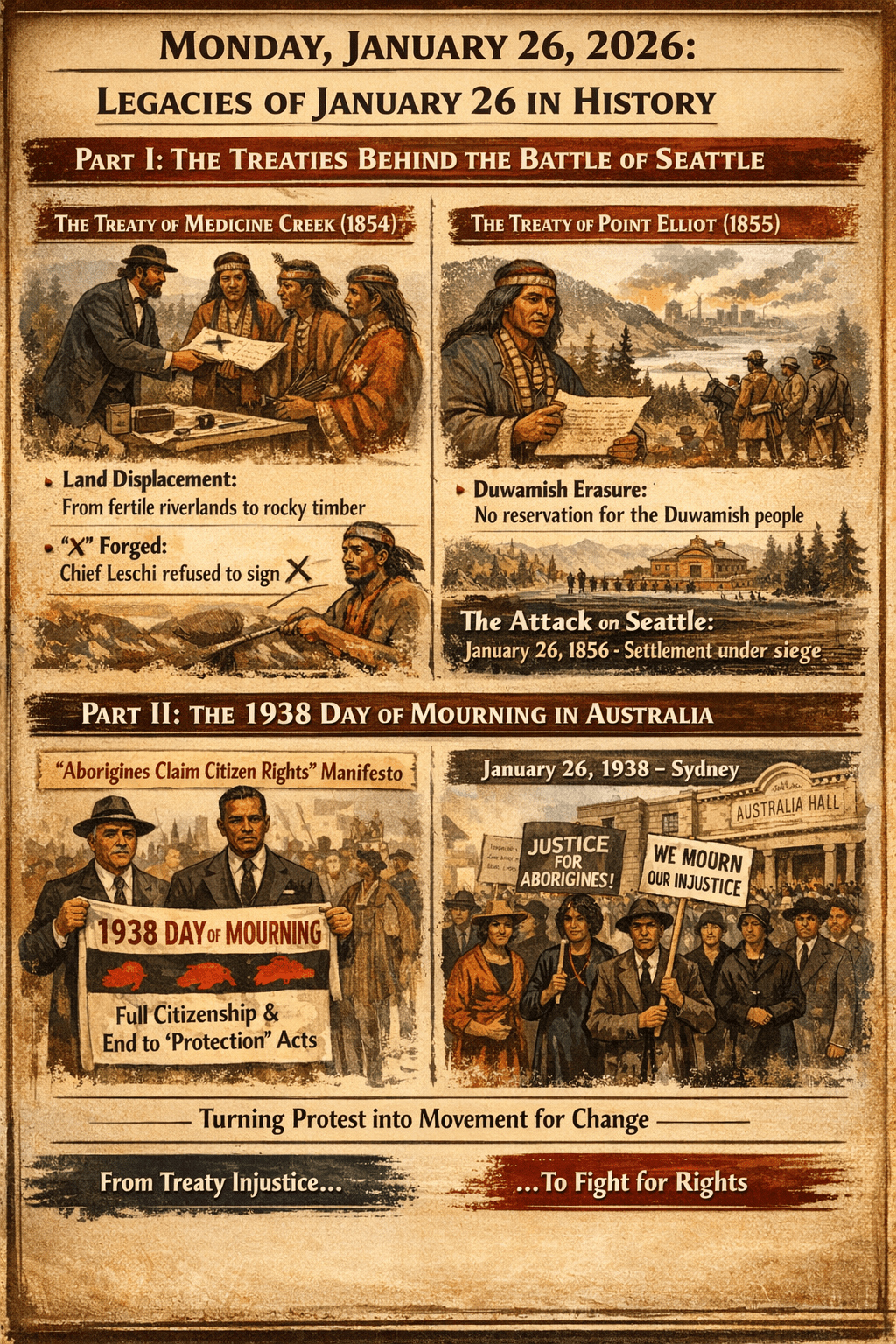
Monday, January 26, 2026
This outline provides an in-depth look at the legislative and social catalysts behind the Indigenous historical events of January 26. It focuses on the treaties that sparked the Puget Sound War and the 1938 protest that defined the modern Australian First Nations movement.
Part I: The Treaties Behind the Battle of Seattle
The attack on Seattle on January 26, 1856, was not an isolated act of aggression but a response to a series of treaties orchestrated by Governor Isaac Stevens between 1854 and 1855.
The Treaty of Medicine Creek (1854)
This was the first of Stevens’ treaties, affecting the Nisqually, Puyallup, and Steilacoompeoples.
- The Conflict of Land: The treaty moved tribes from their ancestral river-bottom lands—essential for fishing and grazing horses—to high, rocky timberland unsuitable for their way of life.
- The Signature Controversy: Chief Leschi of the Nisqually famously refused to sign. Historical records suggest his “X” may have been forged by government officials. This perceived fraud was a primary driver for the subsequent uprising.
The Treaty of Point Elliott (1855)
This treaty involved over 20 tribes, including the Duwamish, Suquamish, and Snoqualmie.
- The Duwamish Erasure: Despite Chief Seattle being the first to sign, the treaty failed to establish a dedicated reservation for the Duwamish people in their own territory. They were expected to move to the reservations of other tribes. To this day, the Duwamish Tribe is still fighting for federal recognition based on the unfulfilled promises of this document.
Part II: The 1938 Day of Mourning
While the British landed in 1788, the modern political movement for First Nations rights in Australia crystallized on January 26, 1938, the 150th anniversary of the First Fleet’s arrival.
The Manifesto: “Aborigines Claim Citizen Rights”
Organized by the Aboriginal Progressives Association (APA), led by William Cooperand Jack Patten, this was the first national protest by Indigenous Australians.
- The Protest: While white Australians celebrated the Sesquicentenary with a reenactment of the landing, Indigenous leaders met at Australia Hall in Sydney. They wore black to signify mourning.
- Key Demands: They issued a manifesto titled Aborigines Claim Citizen Rights, which called for:
- Full citizen status.
- Federal control of Aboriginal affairs (to bypass harsh state-level “Protection” acts).
- An end to the “Protection Boards” that controlled where they lived, who they married, and where they worked.
Legacy of the Day
The 1938 protest transformed January 26 from a day of silent grief into a day of organized political action. It laid the groundwork for the 1967 Referendum, which finally saw Indigenous Australians included in the national census.
Bibliography and References
Primary Sources
- Patten, J. T., & Ferguson, W. (1938). Aborigines Claim Citizen Rights! A Statement of the Case for the Aborigines Progressive Association. Publicist, Sydney. (Foundational manifesto of the Day of Mourning).
- Stevens, I. I. (1854). Treaty of Medicine Creek. National Archives and Records Administration (NARA).
- Phelps, T. S. (1856). Reminiscences of Seattle, Washington Territory and the U.S. Sloop-of-War ‘Decatur’ during the Indian War of 1855-56. (Naval eyewitness account).
Secondary Sources
- Buerge, D. M. (2017). Chief Seattle and the Town that Took His Name. Sasquatch Books. (Detailed analysis of the Battle of Seattle and tribal politics).
- Heiss, A. (2018). Growing Up Aboriginal in Australia. Black Inc. (Contextualizes the modern “Survival Day” experience).
- Meeker, E. (1905). Pioneer Reminiscences of Puget Sound: The Tragedy of Leschi.Lowman & Hanford. (A sympathetic pioneer account of the injustices faced by the Nisqually).
- National Museum of Australia. “Day of Mourning.” Defining Moments in Australian History. [Online Resource].
- Wilkinson, C. (2005). Blood Struggle: The Rise of Modern Indian Nations. W. W. Norton & Company. (General history of treaty rights and tribal sovereignty).
 The Writings of Felina Silver
Leave a comment