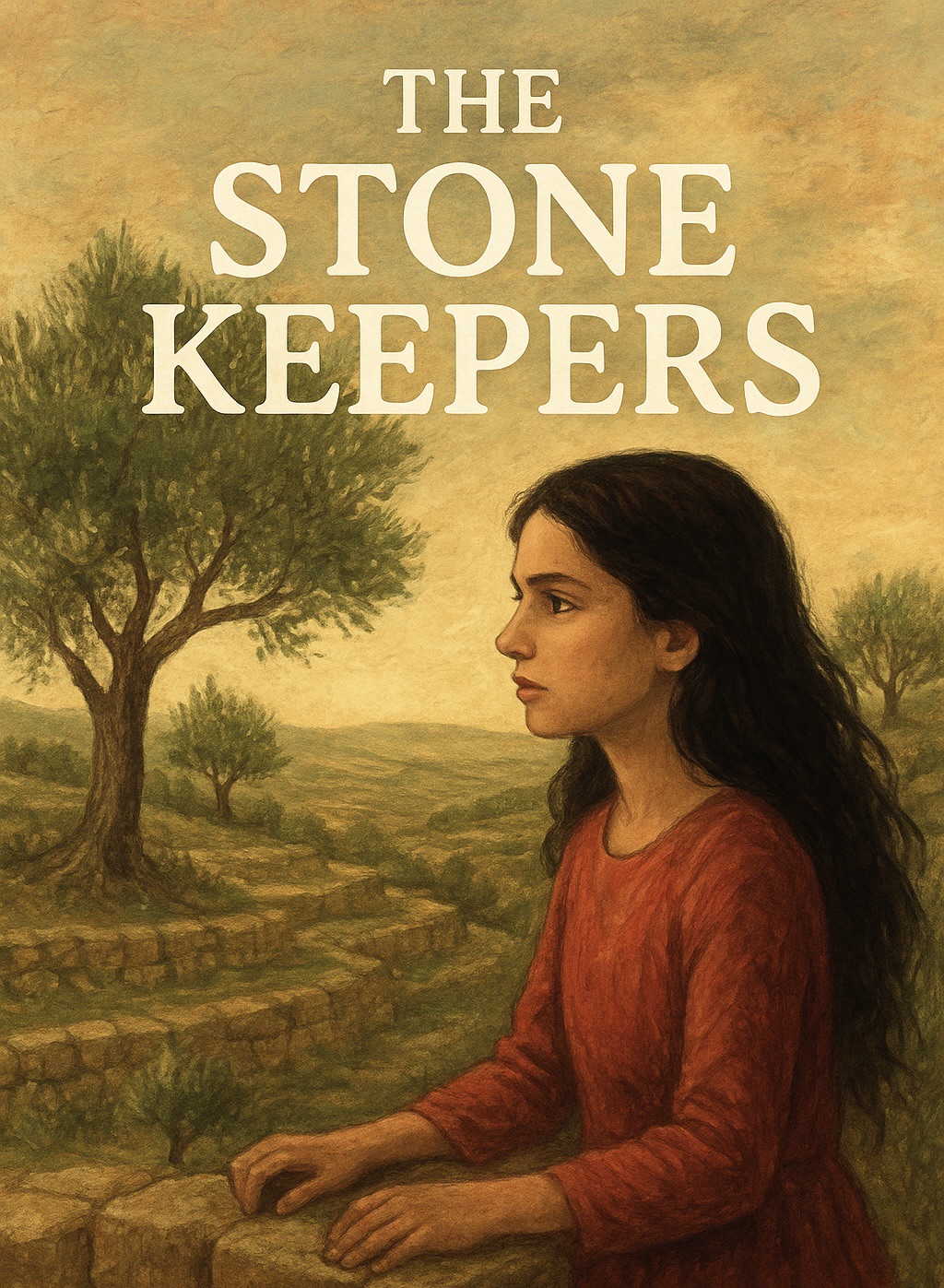
from the point of view of Maysa Samira Khalil (all characters are fictional)
Chapter One — Stones That Remember
My earliest memory is of stones.
Not toys, not lullabies, not the scent of my mother’s hair after she washed it with jasmine soap.
No—stones.
Specifically, the sun-warm stones of our courtyard in Bir al-Safa, each one set by a hand I never knew, each one holding a story. My grandmother, Teta Samira, would sit me on her lap and say:
“Ya Maysa, your ancestors built with stone so the land could speak long after we are gone.”
For years, I thought she meant that metaphorically.
But now, at fifteen, as I kneel on that same courtyard floor, brushing my fingers across the ridge where one stone meets another, I feel something deeper.
A kind of memory under my skin.
A trembling.
A warning.
The settlers’ construction has begun on the northern hill—giant metal claws tearing into earth like they’re skinning an animal. They call it “expansion.” My father says it’s colonization wearing a bureaucrat’s suit.
Whatever it is, it’s getting closer.
And the stones feel it.
Almost… screaming.
Chapter Two — The Boy on the Rock
I see him again today—the lonely boy sitting on the ridge where the valley folds into the hills. He always chooses the same boulder, carved smooth by centuries of wind.
His name is Yousef.
I met him three weeks ago, the day after bulldozers erased his village, Al-Kharouf. His family escaped with little more than blankets and a dozen jars of pickled olives.
Today, he stares toward his lost home, fingers tracing the holes in his wooden flute.
“You’re early,” I say.
He shrugs. “Didn’t sleep.”
“Construction noise?”
“No,” he says. “Nightmares.”
I sit beside him.
The wind sighs through the thyme bushes below. For a moment, the tension in Yousef’s shoulders loosens.
He lifts the flute to his lips and plays a slow, trembling melody. It sounds like someone trying to remember a prayer while their world is burning.
When he finishes, I whisper, “It’s beautiful.”
He shakes his head. “It’s grief.”
“Same thing sometimes.”
He turns toward me then, studying me the way you study a horizon—you think you know it, but it keeps stretching farther.
“My father says the Nakba never ended,” he murmurs. “It just changes shape.”
“My grandmother says we’re stone keepers,” I reply. “As long as we stay, the land stays.”
He gives a bitter laugh. “Sounds exhausting.”
“It is.”
But it’s also all we have.
Chapter Three — Fire in the Groves
Night falls thick and hot.
I’m washing dishes when I hear shouting—raw, frantic.
“Maysa!” Mama screams from outside. “Come!”
I drop the plate. Glass shatters at my feet. I don’t care.
I run barefoot into the courtyard.
And stop breathing.
The olive groves are on fire.
Flames roar upward like orange beasts. Smoke turns the sky black. Sparks rain across the terraces.
Settlers—masked, armed—run between the trees carrying torches, gasoline cans, metal pipes.
Soldiers stand behind them, watching.
I cannot move.
My father pushes past me, grabbing a shovel. Neighbors rush beside him, carrying buckets and blankets.
“Let me help!” I cry.
Mama yanks me back. “No, Maysa! Stay with your Teta!”
Grandmother grips my arm with fingers sharper than bone. “Witness, habibti,” she whispers. “Witness.”
But witnessing feels like drowning while everyone you love burns.
Hours later, the fire sputters out.
The grove—our history, our pride—is a charred skeleton.
I walk among the ashes, numb.
And then I see them.
Tiny.
Green.
Alive.
New shoots.
Olives always fight back.
“So do we,” I whisper.
At least, I hope so.
Chapter Four — The Activists
Word spreads.
Burned groves.
Eviction notices.
A village under threat.
Activists begin arriving by the dozen—students from Ramallah, organizers from Haifa, foreigners who speak Arabic like their tongues are made of marbles.
They bring cameras. Solar chargers. Legal documents. Hope, maybe.
Among them is Noura, a law student with a fierce voice and a backpack full of first-aid kits.
“You’re young,” she says to me. “But your voice is strong. We need you.”
I don’t feel strong.
Not when the fire’s smoke still clings to my clothes.
Not when the settlers drive past, laughing.
Not when the eviction notice clings to our door like a threat scrawled by fate.
But I nod anyway.
Noura squeezes my shoulder. “You’re braver than you think.”
I wish I believed her.
Chapter Five — Eitan Lavee
He arrives in a white Jeep, polished like a bone.
The settlers step aside to let him through.
A man steps out—clean uniform, smug smile, eyes cold enough to stop a river.
Eitan Lavee.
The new settlement commander.
He unrolls a document and reads:
“By territorial decree, all structures near the northern road are subject to demolition within fourteen days.”
My father steps forward. “This is our home.”
Eitan barely glances at him. “Not for long.”
I swear I feel the stones under my sandals tremble.
My grandmother spits at the ground. “We survived Crusaders and Ottomans and Mandates. You are temporary.”
Eitan smiles—not kindly.
Like a man who enjoys breaking things.
Especially people.
Chapter Six — The Human Wall
The next morning, we form a line across the northern road.
All of us.
My parents.
My grandmother.
Me.
Yousef.
The activists.
Farmers. Teachers. Infants strapped to their mothers.
A river of bodies refusing to move.
Cameras flash. Drones buzz. Soldiers watch uneasily.
Eitan approaches.
He stops inches from my face.
I want to disappear.
I don’t.
Teta lifts her chin. “We are the stone keepers.”
We repeat it.
Again.
Louder.
Something flickers in Eitan’s eyes.
Annoyance.
Maybe uncertainty.
He steps back.
Not much.
But enough.
For one night, we win.
Chapter Seven — Blood on the Road
Victory lasts less than two days.
At dawn, soldiers raid the activists’ tents, dragging them out by their hair, beating them with batons.
Noura is thrown against a jeep. Her forehead splits open. Blood pours down her cheek.
I scream.
Yousef pulls me behind a wall. “You can’t help her.”
“I have to!”
“You’ll just get killed.”
I hate him for being right.
By noon, the road is cleared.
By sunset, construction resumes.
And the tremble in the stones becomes a roar.
Chapter Eight — What the Stones Hid
Three days later, Baba brings me to the oldest terrace, where the earth is layered in ancient steps like pages of a book.
He digs at the base of a broken olive trunk.
“Help me,” he says.
We dig until our arms shake.
Something hard emerges.
A stone slab.
Carved.
I brush the dirt away.
A pattern appears—spirals, vines, symbols older than any scripture I know.
“What is this?” I whisper.
“A grave marker,” Baba says softly. “From long before your great-grandfather.”
“Whose grave?”
“Our ancestor,” he says. “One of the first families to settle this valley.”
I trace the carvings with a trembling hand.
“These stones… really do hold memory.”
Baba smiles sadly. “They hold us, Maysa. Now it’s our turn to hold them.”
Chapter Nine — The Night Raid
It begins with headlights.
Then boots.
Then shouting.
Soldiers flood into the village, banging on doors, dragging men out of their beds.
I cling to my mother.
A soldier bursts into our house. He grabs Baba by the collar.
“Suspected involvement in illegal protest activity,” he barks.
“He hasn’t done anything!” I scream.
The soldier slaps me so hard I hit the wall.
Mama wails.
Teta curses in three languages.
Baba’s eyes meet mine as they drag him away.
“Stay strong, stone keeper,” he whispers.
Then he’s gone.
Chapter Ten — The World Turns Its Head
Noura recovers enough to help file complaints, organize demonstrations, contact journalists.
Videos of the raid spread.
Some people care.
Most scroll past.
“People don’t look until the blood pools,” Noura mutters. “And sometimes not even then.”
Still—we keep fighting.
We hold rallies.
We block bulldozers.
We plant new olive saplings in the burnt grove.
Every small act feels like shouting into a canyon where the echo never returns.
Chapter Eleven — The Settler Boy
A boy around my age approaches me one afternoon near the edge of the road—a settler boy, pale-skinned, blue-eyed, wearing a knitted kippah.
I stiffen.
“Don’t run,” he says quietly. “Please.”
I don’t trust him.
But I don’t run either.
“My name is Aaron,” he says. “My family just moved to the new outpost.”
Of course they did.
He glances at the distant construction. “My father says this land was empty.”
“Your father is wrong.”
“I know.”
That surprises me.
He kicks at a pebble. “I just… wanted to say sorry. For everything.”
I study him carefully. “Why tell me?”
“Because,” he says slowly, “I see what my father refuses to see. You belong here.”
Anger swells in my chest. “We shouldn’t need your permission.”
“I know that too.”
He looks ashamed.
And suddenly I feel pity.
But pity is complicated when someone’s family is building their home on your ruin.
Chapter Twelve — The Breaking Point
Two weeks pass.
Baba is still imprisoned.
The settlers pour foundations for homes on the hillside.
Bulldozers reach the first house in our village.
My house.
My bedroom window.
My courtyard stones.
My world.
Mama screams at the soldiers.
Teta throws herself in front of the machine.
I run to the olive grove.
I kneel in the ashes and press my palms against the earth.
“Please,” I whisper.
“To whoever hears. To whoever remembers. Help us.”
The ground is silent.
Then—
A tremor.
A small one.
But real.
The earth shifts under my hands, and the fresh shoots—our newborn olive sprouts—quiver like they’re listening.
I feel something.
Strength.
Resolve.
Rage.
The kind carried by generations.
I stand.
And I run back to the road.
Chapter Thirteen — The Final Stand
Hundreds gather—villagers, activists, journalists, even Aaron, standing nervously at the edge of the crowd.
Together, we form a human wall again.
Bigger this time.
Stronger.
The bulldozer halts.
Eitan steps forward, annoyed but cautious—there are too many cameras, too many witnesses.
“You think this will stop me?” he demands.
“No,” I say, surprising myself.
Everyone turns.
My voice is steady. “But we will still be here tomorrow. And the day after. And the day after that.”
Eitan laughs. “Why? You think this land belongs to you?”
“It remembers us,” I say. “Do your stones remember you?”
A murmur passes through the crowd.
Eitan’s jaw tightens.
But he steps back.
He signals the bulldozer to retreat.
Not defeated—just delayed.
But delay is survival.
And survival is resistance.
Chapter Fourteen — The Letter
Two days later, Baba returns.
Bruised.
Thinner.
But alive.
He hugs me so tightly I can barely breathe.
“I saw videos while I was inside,” he whispers. “You were incredible.”
I shake my head. “I was terrified.”
“Courage isn’t the absence of fear,” he says. “It’s action despite it.”
Later that night, he hands me an envelope.
“What is this?” I ask.
“A letter from an international heritage institute.” He smiles. “They’ve been watching our case. They want to designate our olive terraces as a protected cultural landscape.”
My heart stops.
“And that means…?”
“If it goes through,” he says quietly, “the bulldozers cannot touch this land.”
Chapter Fifteen — Roots
The process takes months.
Petitions.
Hearings.
More threats.
More nights spent wondering if we’ll be evicted at dawn.
But finally—finally—
The ruling comes.
Our land is protected.
Not fully.
Not permanently.
Nothing in Palestine ever is.
But it is a victory.
A real one.
The settlers cannot expand—for now.
The bulldozers leave—for now.
And Bir al-Safa breathes again.
We plant new olive saplings together—hundreds of them.
Yousef smiles for the first time in months.
Noura cries with relief.
Aaron watches from the hilltop, unsure where he belongs.
And I—
I kneel, pressing my hands into the soil, feeling its warmth.
Its memory.
Its heartbeat.
“You held us,” I whisper. “Now we will hold you.”
The stones feel still beneath my palms.
Calm.
At peace.
For now.
Because we are their keepers.
And they are ours.
Forever.
The Stone Keepers of Palestine ©️🗿 By Felina Silver (Copyright 2025)
In the hills where the olives whisper
and apricot winds glide by,
live the ancient Stone Keepers—
small as sparrows, swift as sigh.
Their cloaks are sewn from moonlight,
their pockets full of sand,
and every dawn they wander
through the creases of the land.
They polish stones of story,
round and warm and wise,
each one holding echoes
of a thousand lullabies.
They hum to sleeping limestone,
wake pebbles from their dreams,
turn whispers into rivers,
and footfalls into streams.
At night they stack the silence
in careful little mounds,
so shepherds hear the starlight
and children hear the ground.
Some say they’re made of earthdust,
some say of ancient rhyme,
but everyone agrees they keep
the heartbeat of the time.
So if you find a stone that hums
soft music in your hand,
you’ve met a Keeper’s treasure—
a spell of Palestine’s land.
Hold it close and listen,
you may hear distant feet
of tiny guardians wandering
where memory and magic meet.
 The Writings of Felina Silver
Leave a comment